RIA vs. MFD: The Real Cost of "Free" Advice and Which One You Need
October 28, 2026
For decades, Indian investors grew accustomed to receiving financial guidance without ever writing a cheque for it. A bank relationship manager or a mutual fund distributor helps you complete your KYC, picks three or four funds, sets up your SIP, and never bills you for their time.
To most retail investors, this feels like a great bargain: personalized investment support at zero visible cost.
In reality, there is no free lunch in financial markets. The cost of distribution advice is silently deducted every single day from your investments through higher expense ratios in Regular Plans.
With the emergence of SEBI Registered Investment Advisers (RIAs), investors now face an important choice: Should you manage your wealth through a Mutual Fund Distributor (MFD) or partner with an independent RIA?
Understanding the legal responsibilities, commercial incentives, and long-term math behind both options is critical for any serious wealth builder.
What Is an MFD and What Is an RIA?
While both professionals operate in the mutual fund ecosystem, their legal roles, regulatory masters, and compensation structures are completely different.
1. Mutual Fund Distributor (MFD)
- Regulatory Authority: Registered with the Association of Mutual Funds in India (AMFI) holding an AMFI Registration Number (ARN).
- Legal Role: An MFD is an agent of the Asset Management Company (AMC). Under SEBI regulations, distributors can only facilitate product execution and provide incidental suitability checks. They are legally barred from calling themselves “financial advisers” or claiming to offer comprehensive financial planning.
- Compensation Model: They receive ongoing “trail commissions” directly from mutual fund houses. These commissions are embedded in the scheme Total Expense Ratio (TER) of Regular Plans and deducted daily from the fund Net Asset Value (NAV).
- Fiduciary Duty: MFDs have no legal fiduciary duty toward you. Their primary contractual agreement is with the fund houses whose schemes they distribute.
2. Registered Investment Adviser (RIA)
- Regulatory Authority: Registered directly with the Securities and Exchange Board of India (SEBI) under the SEBI (Investment Advisers) Regulations, 2013.
- Legal Role: An RIA is an independent professional who works exclusively for the investor.
- Compensation Model: RIAs are strictly prohibited by SEBI from accepting any commissions, brokerage, or kickbacks from fund houses or product issuers. They are compensated transparently and directly by the client, typically through a flat annual fee or a fee linked to assets under advice (capped by SEBI).
- Fiduciary Duty: RIAs are bound by law to a strict fiduciary duty. This means they are legally mandated to place the client financial interest above everything else, including their own.
The Key Advantages of an RIA Over an MFD
The structural differences between the two models give RIAs four distinct advantages:
1. Elimination of Conflicts of Interest
An MFD earns different commission rates depending on the product sold. Equity funds pay roughly 0.5% to 1.5% in annual trail fees, while debt funds pay a fraction of that, and direct government bonds or liquid funds pay virtually nothing.
This creates an inherent conflict: a distributor has an active financial incentive to keep you in high-commission equity funds, recommend frequent portfolio churn, or pitch new fund offerings (NFOs).
An RIA earns the exact same advisory fee regardless of where your money is parked. Whether your financial plan calls for an equity index fund, a low-cost debt instrument, repaying an expensive home loan, or maintaining cash in an emergency fund, the advice remains unbiased.
2. Mandatory Direct Plan Recommendations
Because RIAs cannot earn distributor commissions, they advise exclusively on Direct Plans.
Direct Plans bypass distributor commissions, offering lower expense ratios that typically save between 0.50% and 1.25% per year compared to Regular Plans. That savings stays inside your fund, compounding in your favor year after year.
3. Holistic Financial Planning Across Your Life
An MFD can only sell you mutual funds. They cannot officially advise on your overall asset allocation, pure risk protection (such as term life and health insurance), debt elimination, tax optimization, or emergency liquidity.
An RIA looks at your complete balance sheet, integrating cash flow planning, goal mapping, insurance coverage, and retirement decumulation (such as Systematic Withdrawal Plans) into a cohesive strategy.
4. Transparent, Capped Fee Structure
With an MFD, you never see an invoice, but the trail commission compounds continuously as your portfolio expands. With an RIA, you pay a known, explicit fee that does not arbitrarily skyrocket simply because the market doubled.
The Math: Comparing Fees on a ₹1 Lakh Monthly SIP Over 10 Years
To see the real-world impact of these models, consider an investor committing to a monthly SIP of ₹1,00,000 for 10 years (120 installments).
- Total Principal Invested: ₹1,20,00,000 (₹1.20 Crore)
- Fund Return: 12.0% p.a. in the Direct Plan
- Regular Plan Return: 11.15% p.a. (reflecting a typical 0.85% annual trail commission spread)
- RIA Fee Model: An advisory fee starting at ₹30,000 in Year 1, increasing by 5% each year (reflecting standard annual fee adjustments over a decade)
| Metric (After 10 Years) | Investing via MFD (Regular Plan) | Investing via RIA (Direct Plan) | The RIA Advantage |
|---|---|---|---|
| Total Capital Invested | ₹1,20,00,000 | ₹1,20,00,000 | Identical Capital |
| Gross 10-Year Corpus | ₹2,14,12,942 | ₹2,24,03,589 | +₹9,90,647 higher corpus |
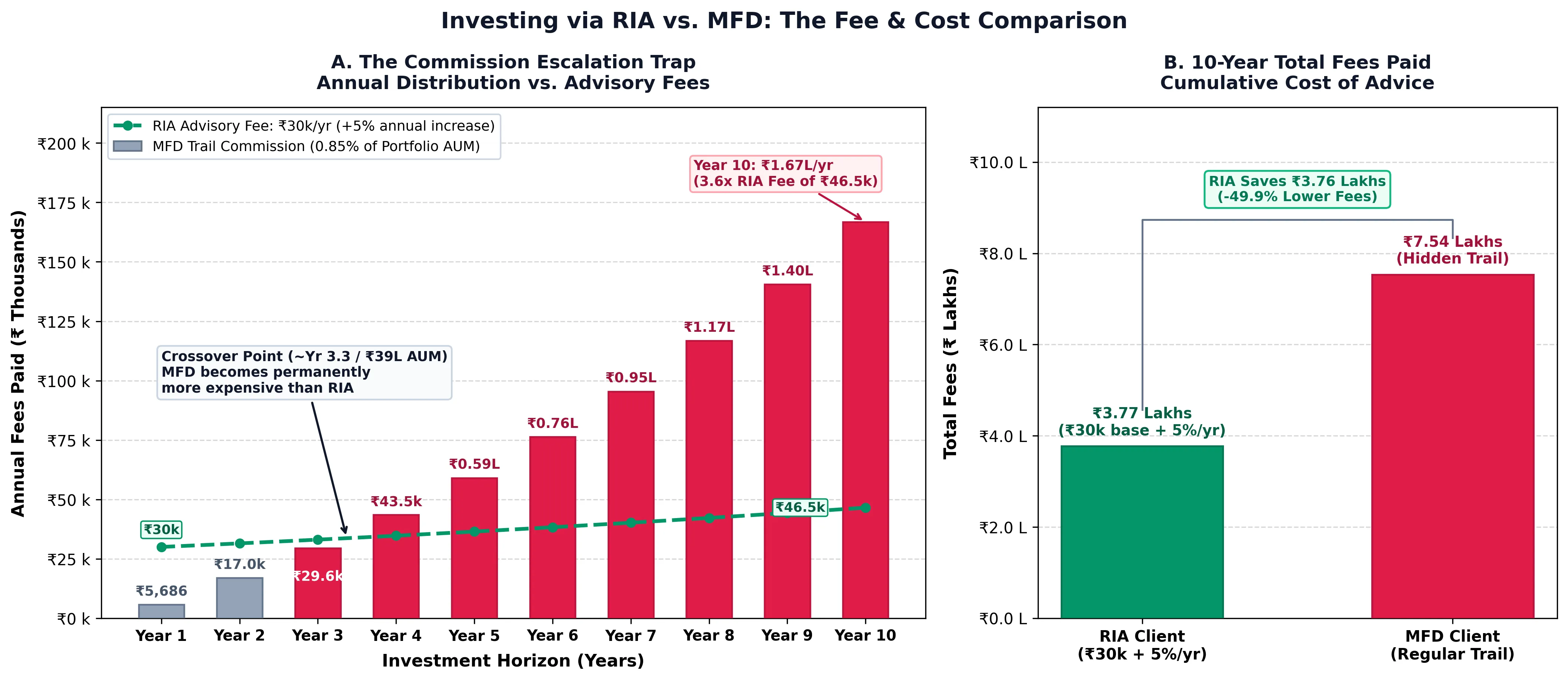
| Fees Paid Over 10 Years | ₹7,53,550 (Hidden trail commission) | ₹3,77,337 (Direct fee: ₹30k base + 5%/yr) | Saves ₹3,76,213 in fees |
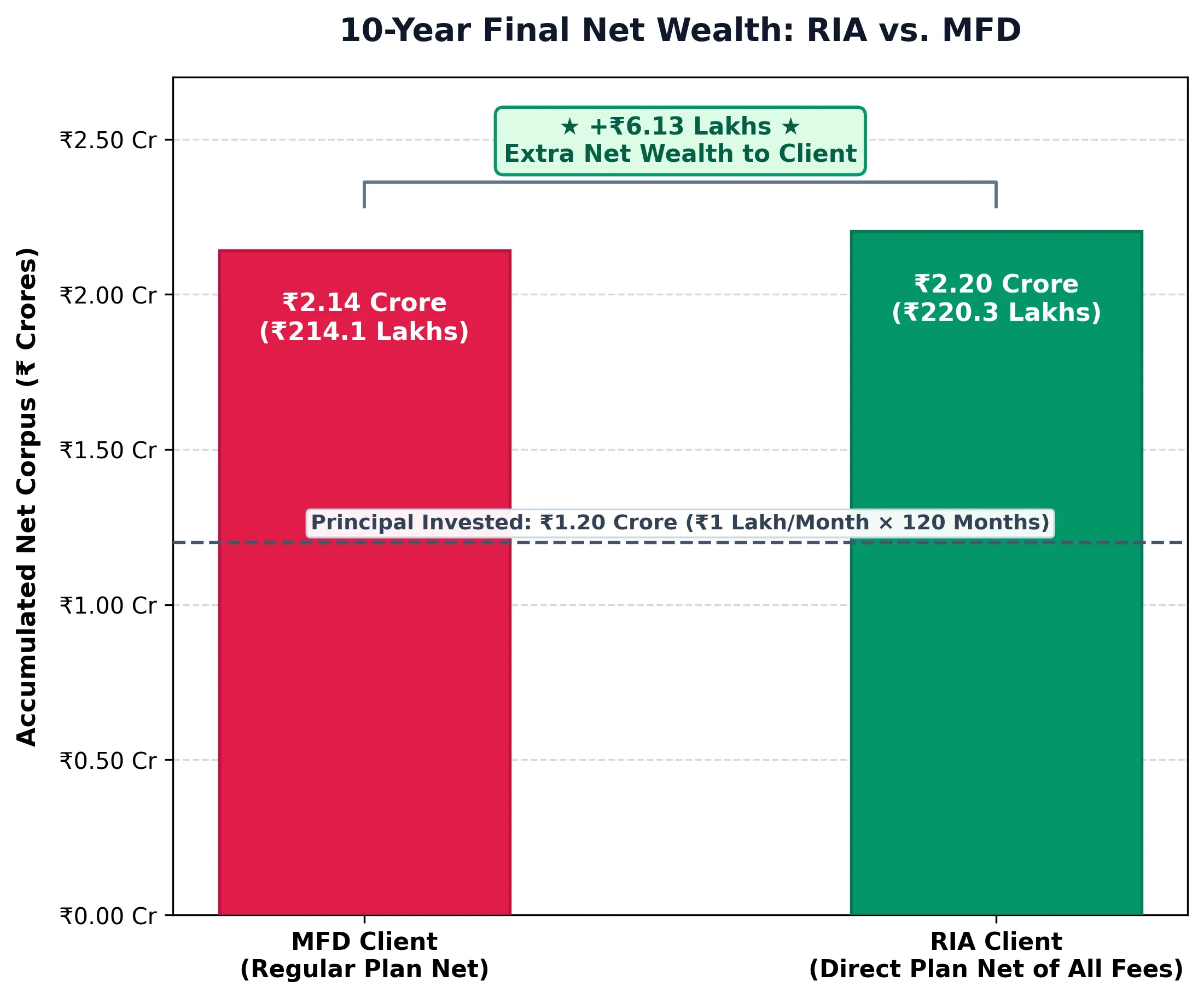
| Net Wealth (After All Advisory Fees) | ₹2,14,12,942 | ₹2,20,26,252 | +₹6,13,310 extra net wealth |
The Commission Escalation Trap
In Year 1, when your portfolio balance is small, the MFD commission seems trivial: roughly ₹5,700 (₹5,686) over the entire year. Paying a ₹30,000 fee to an RIA might initially seem more expensive.
However, as your portfolio scales, the math shifts dramatically:
- By late Year 3 (around Month 33, when your portfolio crosses ~₹39 Lakhs), the monthly distributor commission permanently surpasses the RIA monthly fee.
- By Year 5, the MFD collects around ₹59,000 per year in trail commissions (vs. ₹36,500 for the RIA).
- By Year 10, the MFD quietly pockets ₹1,66,810 per year (over ₹1.67 Lakhs annually) from your ₹2.1 Crore balance.
- If you hold that ₹2 Crore portfolio for another decade without adding a single rupee, the MFD continues collecting ₹1.7 Lakh to ₹2.0 Lakhs every year in perpetuity.
The RIA fee, even when escalating by 5% annually to adjust for cost of advice and inflation, grows to ₹46,540 in Year 10. At that stage, the distributor trail commission is 3.6 times higher than the RIA fee.
Even after paying ₹3,77,337 out of pocket to the RIA over the decade, the investor walks away with over ₹6.13 Lakhs in extra net wealth, alongside professional fiduciary oversight.
Conclusion: Which One Should You Choose?
Both MFDs and RIAs serve valid purposes in the Indian financial landscape, depending on where you stand in your wealth journey:
| Investor Profile | Recommended Partner | Primary Rationale |
|---|---|---|
| Small SIP Starter (Investing ₹2,000 to ₹10,000 monthly) | Mutual Fund Distributor (MFD) | An RIA fee of ₹20,000 to ₹30,000 is too large a percentage of a small portfolio. The nominal rupee commission in regular plans is more cost-effective while building early capital. |
| Serious Wealth Builder (Investing ₹25,000 to ₹1 Lakh+ monthly) | Registered Investment Adviser (RIA) | As accumulated capital crosses ₹25 Lakhs to ₹50 Lakhs, distributor trail commissions quickly outstrip RIA advisory fees. Direct plan compounding creates massive wealth alpha. |
| Complex Financial Needs (Multiple goals, business income, estate planning) | Registered Investment Adviser (RIA) | High-net-worth investors require unbiased fiduciary advice across taxes, asset allocation, and risk management that distributors cannot legally provide. |
The key is recognizing that convenience has a price tag. If your portfolio is small and you need basic execution support, an MFD provides a useful entry point.
However, once you are accumulating substantial capital, paying an upfront, transparent fee to an RIA is not an added expense: it is an investment that protects your returns, eliminates conflicts of interest, and keeps more wealth in your pocket.
This article is for financial education only, this does not constitute investment advice.
Investment in securities market are subject to market risks, read all the related documents carefully before investing.