Direct vs. Regular Mutual Funds: The Long-Term Cost of 'Free' Advice
August 15, 2026
If you invest in mutual funds through a bank relationship manager, a local broker, or a distributor platform, you have probably never received an invoice for their services. There is no advisory fee billed to your credit card and no upfront charge deducted from your bank account. To many investors, this creates a comforting illusion: the advice feels completely free.
In reality, mutual fund distributors are compensated through ongoing commissions embedded directly inside your funds. This expense is deducted daily from the scheme’s Net Asset Value (NAV) via the Total Expense Ratio (TER).
Because the deduction is hidden inside the daily price of your fund, most investors view a difference of 0.50% to 1.50% per year as insignificant. However, cost deductions in mutual funds compound in reverse. Over a 20 or 30-year investing horizon, that seemingly minor percentage gap does not cost you 1% of your wealth: it can quietly erase 10% to 28% of your total lifetime portfolio.
The Concept: Where Does the Money Go?
Every mutual fund scheme in India is offered in two variants with identical portfolios and identical fund managers:
- Direct Plans: You invest directly with the Asset Management Company (AMC) or through zero-commission investment platforms. Because no intermediary is involved, the fund charges only the core operational and investment management fees.
- Regular Plans: You invest through an intermediary (a bank, distributor, or broker). The fund house charges the same operational expenses plus an ongoing distributor commission (the “trail commission”), typically ranging between 0.50% and 1.50% annually.
This commission is not charged once; it is deducted every single day on your entire accumulated portfolio balance for as long as you remain invested. As your wealth grows from ₹5 Lakhs to ₹50 Lakhs, the annual commission paid to your intermediary automatically scales up ten-fold, even if you never receive another phone call or portfolio review.
Real-World Evidence: 10 Years of Actual NAV Data
To see how this plays out in reality rather than on a spreadsheet, we evaluated daily historical NAV records over a complete 10-year period (May 2016 to May 2026). Because SEBI introduced Direct Plans in January 2013, a 10-year window provides 100% authentic, uninterrupted empirical market data without any synthetic backfilling. We tracked a standard SIP of ₹10,000 per month (total principal invested: ₹12.0 Lakhs over 120 monthly installments) across five representative scheme categories:
| Scheme Name | Category | Regular TER | Direct TER | Commission Spread | Direct SIP Final Corpus (₹) | Regular SIP Final Corpus (₹) | Wealth Lost to Commission (₹) | Direct SIP Outperformance |
|---|---|---|---|---|---|---|---|---|
| DSP Small Cap Fund | Small Cap Equity | 1.68% | 0.78% | 0.90% p.a. | ₹32,40,902 | ₹30,72,940 | ₹1,67,962 | +5.47% |
| ABSL Flexi Cap Fund | Flexi Cap Equity | 1.63% | 0.84% | 0.79% p.a. | ₹25,70,992 | ₹24,40,320 | ₹1,30,673 | +5.35% |
| ABSL Large Cap Fund | Large Cap Equity | 1.62% | 0.97% | 0.65% p.a. | ₹23,06,950 | ₹22,11,604 | ₹95,346 | +4.31% |
| ABSL Arbitrage Fund | Arbitrage Hybrid | 1.06% | 0.32% | 0.73% p.a. | ₹16,76,831 | ₹16,15,650 | ₹61,181 | +3.79% |
| ABSL Corporate Bond | Corporate Debt | 0.51% | 0.33% | 0.18% p.a. | ₹17,27,544 | ₹17,11,737 | ₹15,807 | +0.92% |
*Note: Final wealth numbers reflect actual daily published NAVs (which dynamically factor in each scheme’s actual historical expense changes over time). The TER columns display the latest indicative snapshot.
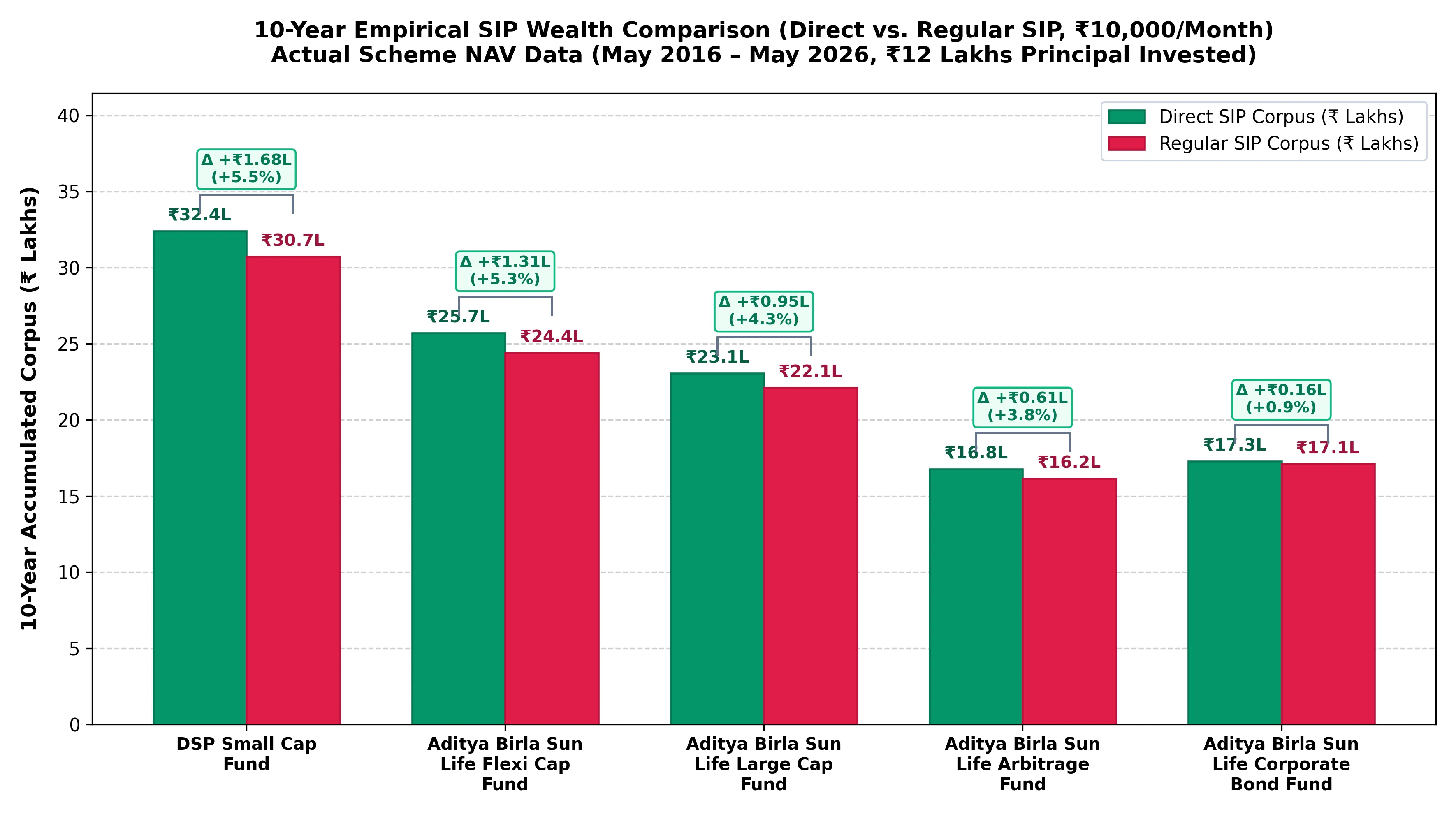
On a ₹10,000 monthly SIP in the DSP Small Cap Fund, choosing the Direct Plan created an extra ₹1.68 Lakhs of wealth for the investor on a ₹12 Lakh capital outlay (+5.47% outperformance). In the ABSL Flexi Cap Fund, the Direct Plan generated an additional ₹1.31 Lakhs (+5.35% more wealth). Even in a conservative Large Cap fund, commission leakage cost the investor nearly ₹1 Lakh over the decade.
Key Note: The Reverse Compounding Effect
Money lost to distributor commissions does not just leave your account; it stops compounding. Every ₹100 deducted in fees today is ₹100 that cannot generate returns tomorrow, creating an ever-widening wealth gap over time.
The 30-Year Horizon: The Exponential Wealth Drain
While a 10-year difference of ₹1 to ₹1.7 Lakhs on a ₹12 Lakh investment is significant, retirement planning typically spans 25 to 35 years. This is where reverse compounding turns distributor commissions into an exponential wealth drain.
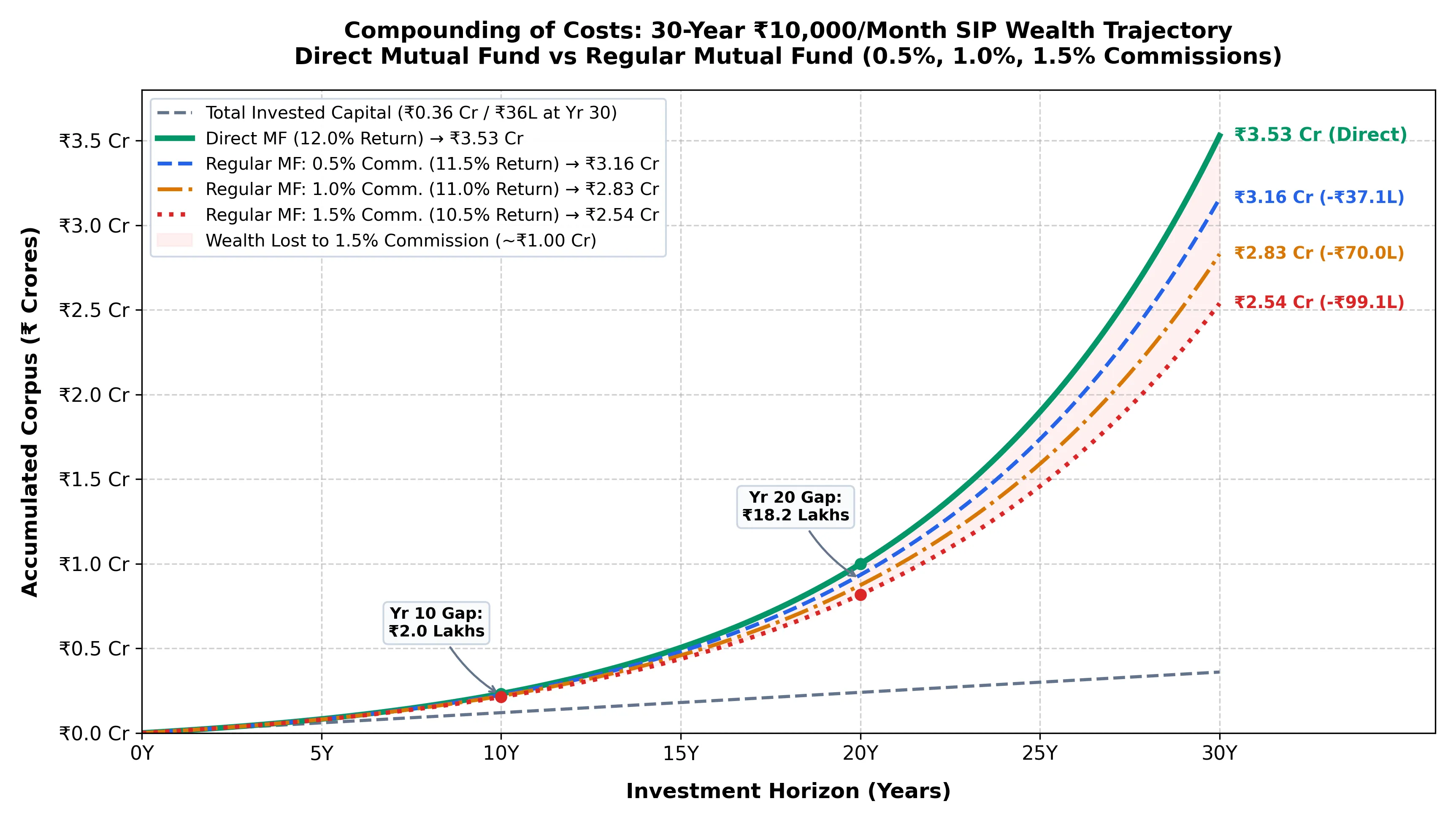
Assuming a baseline return of 12.0% annually for the Direct Fund, here is how much wealth an investor surrenders across three common distributor commission scenarios (0.5%, 1.0%, and 1.5%) on a standard ₹10,000 monthly SIP over 30 years (₹36 Lakhs total capital invested):
| Investment Horizon | Distributor Commission Scenario | Net Regular Fund Return | Direct SIP Corpus (₹) | Regular SIP Corpus (₹) | Total Wealth Lost to Commission (₹) | % Loss of Lifetime Wealth |
|---|---|---|---|---|---|---|
| 30 Years | 0.50% p.a. | 11.50% | ₹3,52,99,140 | ₹3,15,90,840 | ₹37,08,290 | -10.5% |
| 30 Years | 1.00% p.a. | 11.00% | ₹3,52,99,140 | ₹2,83,02,280 | ₹69,96,860 | -19.8% |
| 30 Years | 1.50% p.a. | 10.50% | ₹3,52,99,140 | ₹2,53,84,200 | ₹99,14,940 | -28.1% |
The Math Behind the Loss:
If you run a ₹10,000 monthly SIP for 30 years, your total out-of-pocket investment is ₹36 Lakhs. In a Direct Fund compounding at 12% p.a., your wealth grows to ₹3.53 Crore.
- With a 1.00% commission spread, you surrender ₹69.97 Lakhs to distributor fees: almost double your entire 30-year invested principal!
- With a 1.50% commission spread, you forfeit nearly an entire crore (₹99.15 Lakhs), wiping out over 28% of your total accumulated retirement wealth.
Action Plan: How to Transition to Direct Plans
If you want to plug this wealth leakage, follow these practical steps:
- Audit Your Portfolio: Check your Consolidated Account Statement (CAS). If your fund names do not contain the word “Direct” (e.g., they say “Regular” or “Regular Plan - Growth”), you are in Regular plans.
- Reroute Future SIPs Immediately: Stop ongoing SIPs in Regular plans and start fresh SIPs in the Direct Growth option of the same schemes via AMC portals or direct platforms. This halts new commission leakage on Day 1.
- Manage Existing Units Strategically: Do not rush to switch existing accumulated units all at once. Check for exit loads (typically applicable for 12 months) and capital gains taxes. You can systematically redeem units in tranches to stay within the annual ₹1.25 Lakh long-term capital gains tax exemption limit.
This article is for financial education only, this does not constitute investment advice.
Investment in securities market are subject to market risks, read all the related documents carefully before investing.